Every layer answers a question
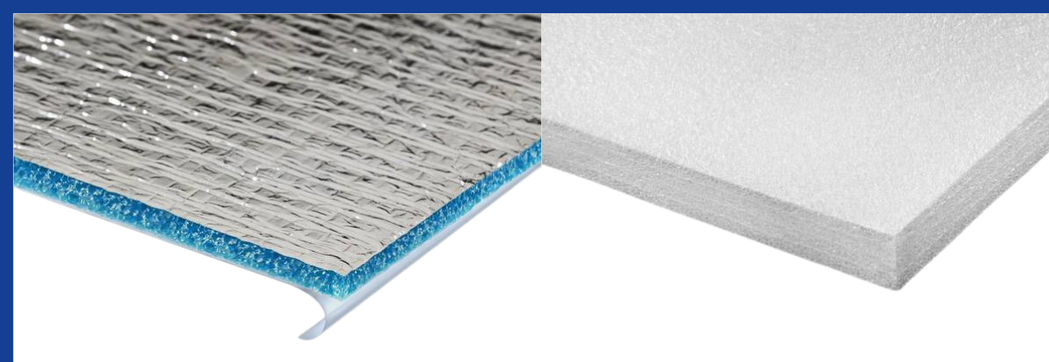
A laminated material always begins with a question: what does this product need to do that foam alone cannot? Polyethylene and polypropylene foam is light and soft, it absorbs shocks and noise, and it is a good thermal insulator, because it slows down the passage of heat. Other functions come from the layers we bond to it: a metallised film or an aluminium foil, for example, reflects radiant heat.
An HDPE or LDPE film protects the surface from scratches, abrasion, dust and moisture. A barrier film stops vapour, a waterproof polymer film keeps water out. And several layers of foam, one on top of the other, become planks up to 120 mm thick. Paper, metallised PET and nonwoven are part of the range of materials we laminate too.
The result is a new material that adds up the qualities of all its layers. On one condition: those layers have to stay together for the whole life of the product. That is where the way we bond them makes the difference.
Why heat and not glue
Foam, bubble film and thermoplastic films share a useful property: heat their surface the right way and it softens just enough to bond with the next layer. As it cools, the bond is made. No adhesives, no solvents, no chemical agents.
For a producer, that means one less raw material to buy and manage, and no system to apply it.
And when the layers belong to the same material family, such as PE foam with a PE film, the result is a mono-material product: a structure that is simpler to recycle than laminates made of different materials.
The hard part: dosing the heat
Hot lamination sounds simple. It is not. With too little heat the layers do not bond properly and sooner or later they separate, often when the material is already at the customer, on their cutting table. With too much heat the foam can be crushed and lose thickness, which is one of the very qualities it was chosen for.
That is why a laminator is, before anything else, a very precise way of delivering heat where it is needed. On our hot rolls, lamination temperature is kept under tight control.
And there is one thing no laminator can do: repair a sheet. Freshly extruded foam keeps releasing gas for hours, sometimes days. If it reaches lamination with uneven thickness, or while it is still degassing, the defect does not show on the line but later, at the customer. That is why, when we talk about lamination, we always ask about what happens upstream too.
Two technologies, two ways of delivering heat
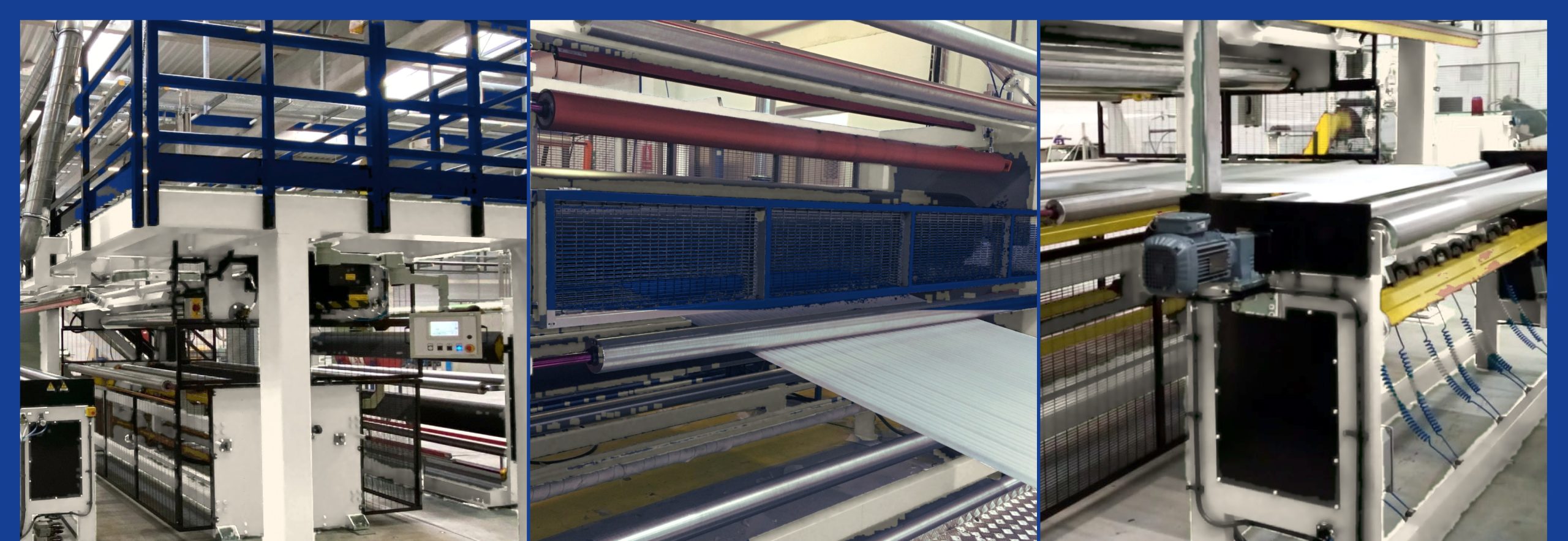
Hot Roll. Heat is transferred by contact, from a roll heated by internal oil circulation. This is our technology for inline lamination: the laminator is mounted right after the extruder and bonds an HDPE or LDPE film onto freshly produced foam or bubble film at the same speed as the line. It is modular, it can be integrated into an existing extrusion line, and its unwinders, floor-mounted or on a mezzanine, are designed for large, heavy reels.
Hot Blade. Here heat comes from hot air blades that warm both surfaces to be bonded at the same time. This is the technology of offline lamination, and the one that lets us work with multiple layers and high thickness. Our multilayer plank line, first developed in the early 2000s to bond several layers of PE and PP foam, laminates from 2 to 6 layers in a single pass, even with different densities, up to 120 mm thick. The number of layers depends on the lamination heads: one double head reaches 3 layers, two double heads plus a single head reach 6. At the end of the line, an integrated cutter brings the material to size.
Both together. When production needs both, the hot roll and the hot air blades work on the same machine, with a double heating lamination head. It is the configuration that gives consistent bonding even between materials of very different thickness and density.
Inline or offline?
Even before the technology, there is a more important question: should lamination be part of the extrusion line, or a machine of its own?
Think of two companies making the same flooring underlay. The first extrudes its own foam and sells kilometres of it, always with the same laminate. For this company, inline lamination makes sense: the foam leaves the extruder, receives the film and is wound, in a single pass at high speed, without a stop in the warehouse.
The second works foam coming from several lines or suppliers, changes material combination often and sometimes needs several layers. For this company, the right choice is an offline line: independent from extrusion, free to work the material when it is ready and to move from one combination to the next.
There is no best laminator in absolute terms, only the one that fits the way a company produces, sells and organises its shifts.
Offline producers often have another need: not stopping. Halting the machine at every reel end means losing material and time. That is why our lines can include a foam accumulator of up to 40 metres and a jointing system, so the reel is changed while lamination keeps running. Unwinding units for light or heavy reels and single or double axle winders complete the configuration.
We build it around the process, and this is the first choice we make together with the customer.
Where our laminates end up
Under floors. A foam underlay softens the feel underfoot, reduces noise and evens out small irregularities in the subfloor. Laminated with a vapour barrier film, it protects the floor from moisture rising from below, especially on concrete.
Under roofs and inside walls. Foam or bubble film laminated with metallised films becomes reflective insulation, combining thermal and acoustic insulation. PE foam with metallised PET film works as universal insulation; PP foam with a waterproof polymer film becomes a vibration-damping layer that keeps water out.
In packaging. Bubble film or foam laminated with HDPE or LDPE film resists scratches, abrasion, dust and moisture. It protects electronics, furniture and automotive components in transit, and is then converted into bags, sheets and custom formats, including for e-commerce. Reflective insulating sheets, on the other hand, travel with temperature-sensitive goods during transport and storage.
In high thickness. Multilayer planks become shock- and vibration-absorbing technical packaging for industrial components and electronics, insulation panels for hangars, cold stores and modular containers, as well as shoe inserts, sports protection, camping equipment and orthopaedic supports.
From Europe to North & South America
Our laminating lines are at work in Europe, North America and South America. Our customers' names stay confidential, but we can tell you what they do.
In several European countries, foam producers for construction and packaging work with our laminators, both inline and offline. One laminates foam and bubble film with a film inline, at high speed, straight off the extruder. And in South America, several companies bond foam to different materials to produce building insulation.
Then there are the materials that appear on no list. We have also laminated foam to rubber, and a special semi-rigid thermoplastic material to a fabric. Each time, the starting point was the same: not a list of materials, but understanding how that material behaves under heat, pressure and tension.
The FAP Method, applied to lamination
A laminator cannot be chosen from a data sheet. It depends on which materials are bonded and at what thickness and density, how many layers are needed, whether lamination happens during extrusion or after it, how often the combination changes and how the finished reels have to reach the next department.
That is why every one of our lines follows the the
FAP Method: feasibility study, design and modelling, coordination with the customer, construction, testing, installation and commissioning. Six steps to build a machine around the way a customer produces. And once the machine is installed, the work goes on: the first runs on the customer's material, the adjustments only real production reveals, the years of support that follow.
This is what we call Co-Engineered Machinery.Our niche is not a list of materials. It is knowing what to ask about one.
Thinking about a new laminate? Discover our laminating lines
Whether you want to add a laminator to an extruder you already have, or build an offline line for new combinations, tell us what you produce and where you want to go. That is where every FAP project begins.

