A company that protects goods on the longest journeys
The company produces protective packaging for goods that travel far and wait a long time before reaching their destination: sea and air freight, and months of storage in tropical heat or freezing conditions. It works with barrier laminates made of film, polyester, nylon and, in some cases, aluminium foil, as well as thermal films. These are thin materials with one very precise job, which is keeping the product sealed and intact for as long as it takes. Cutting was already done in-house, on an ageing machine that still did its job, but slowly and while taking up a great deal of floor space.
With the stated goal of doubling production, that machine had become the bottleneck. The customer had already looked around without finding anything suitable on the market, and the reason was simple: they were not looking for just any cutting machine, but for one that would fit the way of working their team had built over the years.
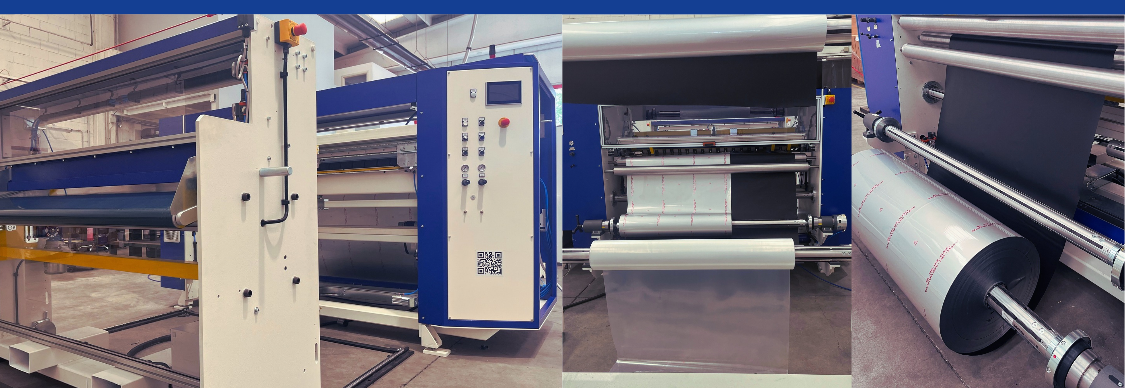
Why adapting an existing machine was not enough
The FlexCut16 was designed for foam and air bubble film, light and soft materials that tend to stay where you put them. The customer’s materials behave almost the opposite way: the reels are much heavier, the films are so slippery that they want to move precisely when they should stay still, and the formats often exceed two or three metres in length, well beyond what the original machine was designed to collect.
The customer came with clear ideas and plenty of suggestions about what the machine could become. During the feasibility study, our job was to work through each of those ideas with them and bring them back down to earth, because with a slippery material the real question is not whether it can be cut, but whether it can be held exactly in position while it is being cut, metre after metre, on every format and every shift.
What we kept and what we rebuilt
We kept what the customer had come to us for, the cutting system, and redesigned the rest of the machine around it. The unwinder was rebuilt as a structure for heavy reels, since the original had been conceived for foam and bubble film and would not have carried that load. The rollers were changed so they could guide and control a material that tends to slip at every pass.
Collection was rethought as well. The collection table became more compact, and we added a fixed table dedicated to long formats, because several metres of barrier film need a surface to lie flat on rather than a stack. The result is a machine that keeps the same cutting principle as the FlexCut16, while every other part of it has been built for an entirely different material and production.
From our workshop to the customer’s plant
Every new machine carries a degree of risk, and that is exactly the kind of challenge we enjoy. Before delivery we ran numerous tests in our workshop to set the machine up the way the customer wanted it. Then came installation and the first start-up on their material, together with the on-site adjustments that are unavoidable in a project like this, because some of the ways a slippery film behaves only show up in real production.
This was followed by a period of testing and training, which lasted until the operators felt fully confident with the line.
Our support did not stop there: operators change over the years, and whenever a new one arrives we are still at the customer’s side.
The results
The machine has been in production since 2025. The customer had set out to double production and, compared with the previous machine, productivity has tripled!!
Cuts are precise and repeatable, with a significant reduction in waste, and the new cutting machine is far more compact than the old one, freeing up valuable space in the plant, as well as being simple and intuitive to use.
There is also a less visible but equally important result, namely leaving behind a technology that had become obsolete. Today this stage of the production process is more modern and reliable, and when maintenance is needed, components are much easier to source.
What now takes the operators time is not learning to use the machine, but getting to know and properly handle the material. That is exactly how it should be, because a well-designed machine serves the material without adding difficulties of its own.
The FAP Method in practice
This project shows clearly what we mean by
the FAP Method: feasibility study, design and modelling, coordination with the customer, construction, testing, installation and commissioning. T
hese six steps allow us to build a machine around a production that already exists and around the people who run it every day, instead of asking that production to adapt to a catalogue machine with a few modifications.
This is what we call Co-Engineered Machinery.It is also why our niche is not a list of materials, but knowing what to ask about each one, even when it is a material we have never worked with before.
Is there a machine you would want “the same, but different”?
If you have ever looked at a machine and thought it would be perfect for you, provided a few things were changed, tell us what you process and what limits you are running into in production today. That is where every FAP project begins.

